
Three words show up in almost every serious AI conversation right now: agents, MCP, and skills. Software companies use them loosely and often interchangeably, which is part of the problem. They are three different things, and knowing the difference is the fastest way to stop nodding along in meetings and start asking the right questions.
This is the plain-English version. No code, no jargon left unexplained. By the end, you will know what each word means, how the three connect, and why the connection matters more than any single one of them on its own.
Three words, one stack
Here is the short version before we slow down and unpack each one:
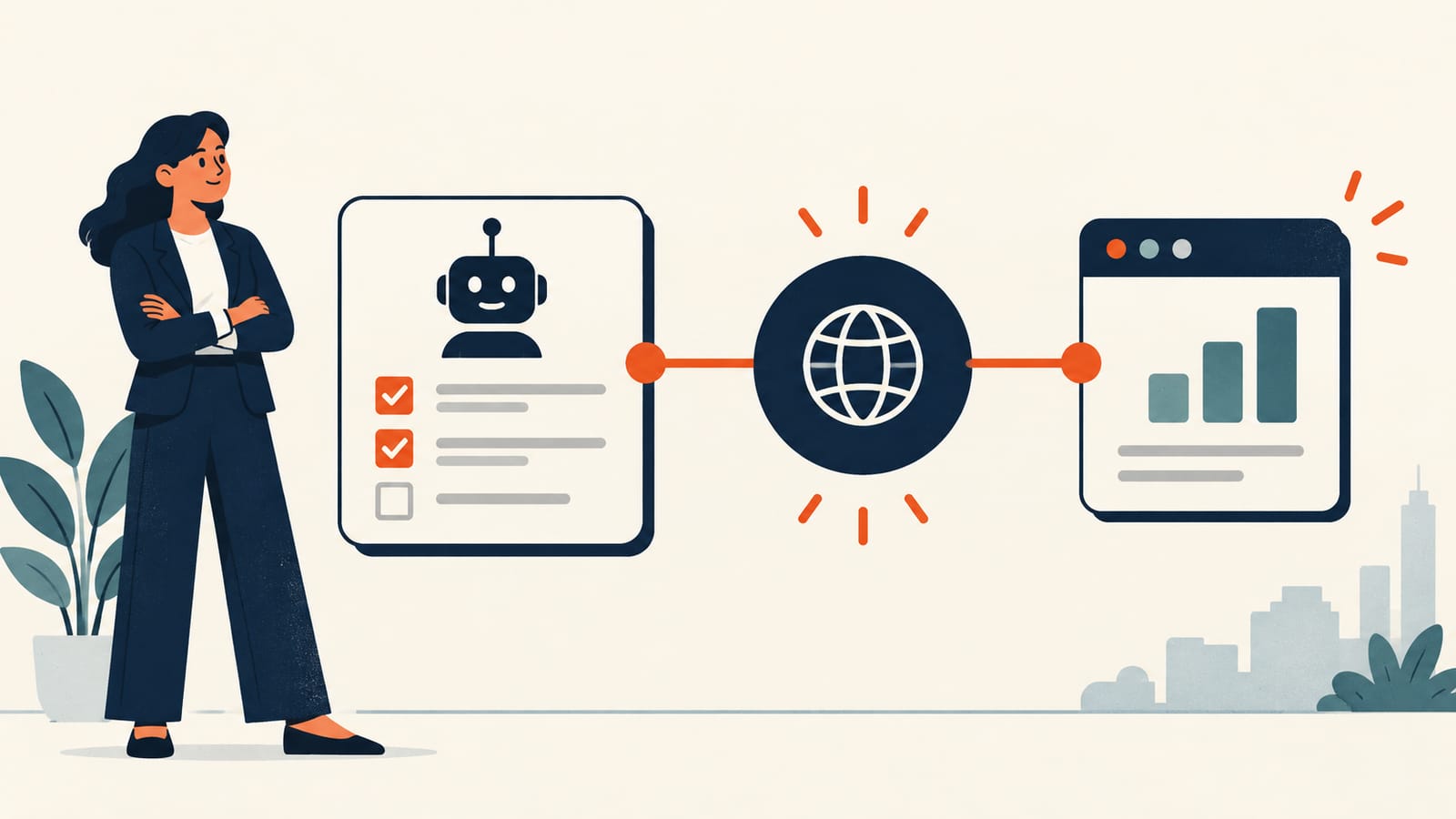
- An agent is the “who.” It’s the AI system doing the work: making small decisions and taking action instead of just answering a question.
- MCP (Model Context Protocol) is how it connects. It’s the standard that lets an agent actually reach your calendar, your files, or your CRM, rather than being stuck with whatever it remembers.
- A Skill is how it learns your way of doing things. It’s a packaged set of instructions that teaches an agent to handle a task the way your business actually does it.
Word one: what is an AI agent?
A chatbot answers one message and stops. You ask, it replies, the conversation ends until you type again.
An agent works in a loop: it takes a goal, decides on a first step, takes an action using a tool, looks at what happened, and decides on the next step — repeating until the goal is done or it needs you to weigh in. Ask an agent to “prepare Friday’s client report” and, given the right access, it can go and pull the numbers, draft the summary, and flag anything unusual, rather than just telling you how you might do that yourself.

This is also where “AI model,” “AI tool,” and “AI agent” start to blur for a lot of people. They are not the same thing. LOKAL has written a full plain-English breakdown of AI tools vs AI models if you want the underlying distinction. Short version for here: a model (such as Claude Sonnet 5.5 or GPT-6.1 Sol) is the engine doing the reasoning; an agent is what you get when that engine is wired up to actually act, not just chat. Anthropic and OpenAI announced those models in September 2026.
Word two: what is MCP (Model Context Protocol)?
Anthropic introduced MCP in November 2024.
Engineers David Soria Parra and Justin Spahr-Summers built it to solve a drag on every AI team: each new software connection required custom work. Multiply that across every AI tool and business system, and you get duplicated integration work.
MCP replaces that mess with one standard connector, the same way a USB-C port replaced a drawer full of proprietary charging cables. Build (or install) an MCP connection to your Google Drive once, and any MCP-compatible AI system can use it, instead of needing its own bespoke plumbing.

MCP is now a cross-vendor standard. OpenAI added MCP support to its Agents SDK in 2025 and remote MCP servers to the Responses API in May 2025. In December 2025, Anthropic donated MCP to the Agentic AI Foundation, a Linux Foundation fund co-founded by Anthropic, Block and OpenAI. Anthropic reported support across ChatGPT, Gemini, Copilot and other clients at the time. These are dated adoption milestones, not a current market-share estimate.
At that point there were more than 10,000 active public MCP servers and over 97 million monthly SDK downloads. This is not one vendor’s proprietary feature. It is closer to plumbing the whole industry has now agreed on.
Word three: what are Skills (and what is a SKILL.md)?
Anthropic introduced Agent Skills in October 2025.
The idea is deliberately unglamorous: a Skill is a folder containing a plain-language SKILL.md file that tells an agent how to do a specific job your way.
Think of it as the onboarding document you would hand a sharp new hire — how we format a client report, what our brand voice sounds like, the checklist we run before anything ships.
An agent without Skills is a genuinely capable generalist who has never worked at your company. An agent with the right Skill loaded has effectively read your SOP.
Anthropic published Agent Skills as an open standard in December 2025. VS Code's current documentation describes support in GitHub Copilot and OpenAI Codex through Agent Host. The SKILL.md convention makes instructions more portable, although supported locations and optional features still vary by agent.
You don’t have to start at Skills, though. The same instinct — write it down once instead of re-explaining it — works one rung lower, in a Claude Project: see how to build a Campaign Brain in 45 minutes. When you are ready to package a procedure, build your first Skill in an hour. And a rung lower still, it’s just writing a clear prompt.
How the three words work together
None of the three does much alone:
- An agent with no MCP connections can reason brilliantly but can’t touch your actual files or systems.
- MCP with no agent behind it is just plumbing with nothing using it.
- A Skill with no agent to load it and no MCP connection to act on is a well-written document sitting in a folder.
Together, they behave like a new team member on their first genuinely useful day: the agent is the person, MCP is their access badge and phone line to every system they need, and the Skill is the training manual they’ve actually read. This is also how we practically run things at LOKAL. The agency operates on Claude end to end, and we’ve written up why we chose Claude over ChatGPT for the longer version of that decision.

Why this matters if you’re not a developer
You don’t have to be a developer for this to affect you.
Any team using Claude, ChatGPT, Gemini, or Copilot already has someone deciding which MCP connections are active and which Skills are loaded, usually the person who set up the account. Those decisions rarely involve anyone else, which makes this a governance and training issue, not only a technical one. If you want the practical version of that, our AI guardrail playbook sets out the review gates and data rules to put around it.
It is also, increasingly, a visibility question. Structuring your own content and systems in ways AI agents can actually read and act on is becoming part of being found at all — see our work on AI SEO in the Philippines and AEO for Australian brands if that side of things is new to you.
LOKAL has trained approximately 1,500 people in the last two years. The tooling matters. Whether your team actually understands what they’re using matters more. If you want the shortlist of what’s worth paying for versus what’s free, our AI tools and models directory is priced out in pesos, Australian dollars and US dollars, and updated monthly.
FAQ
Common questions
Is an AI agent the same thing as a chatbot?
No. A chatbot answers a message and stops. An agent works in a loop — deciding on an action, taking it through a connected tool, checking the result, and deciding what to do next — until the goal is done or it needs a human to step in.
Do I need to understand MCP if I’m not a developer?
Not the technical details. But it’s worth knowing that MCP is the reason an AI agent can (or can’t) actually reach your calendar, CRM or shared drive. If a tool company can’t explain what its agent is connected to, that’s worth pushing on.
What exactly is a SKILL.md file?
It’s a plain-instruction document, bundled in a folder, that tells an agent how to do a specific task your way — think of it as a written SOP that an AI system can read and follow.
Is MCP only for Claude?
No. Anthropic created it, but OpenAI and Google DeepMind both adopted MCP in 2025, and it’s now governed independently through the Linux Foundation’s Agentic AI Foundation rather than owned by any one company.
Which should I learn first: agents, MCP, or Skills?
Start with agents, since that’s the “what am I actually buying” question. Once that’s clear, MCP tells you what it can reach, and Skills tell you whether it will behave the way your business needs it to.
Your next step
Get your team fluent, not just licensed
If you want help putting this into practice, bring one task and its constraints.
Buying licences is the easy part. The gap that costs businesses money sits between having access to Claude, ChatGPT or Copilot and having a team that can point agents, connections and Skills at real work. We run that part — hands-on, in plain language, across Sydney and Manila.