
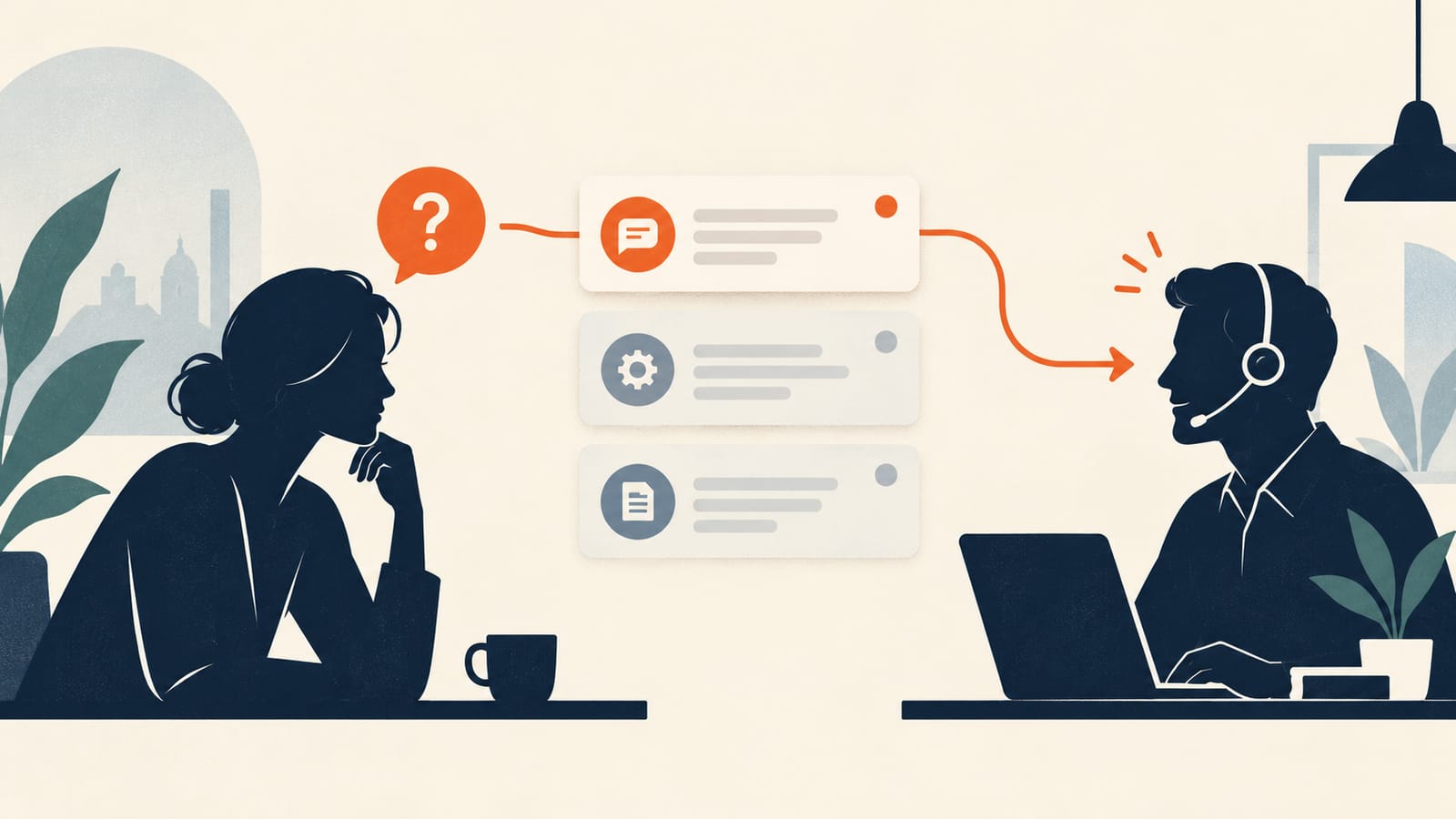
Let AI resolve high-volume, low-judgement tickets that are grounded in a live source — order status, opening times, password reset — and keep a human on anything that commits the business: refunds, complaints, invented policy, or a customer who asked for a person. Copilots from day one; agents only on named intents you have measured. Track first-contact resolution and CSAT, not deflection.
Gartner surveyed 321 customer service and support leaders in October 2025. Ninety-one percent said they were under executive pressure to implement AI in 2026.[1] The pressure is not the hard part. The hard part is the split, ticket type by ticket type: what the bot is allowed to resolve, and what a person still has to own.
Get the split wrong in one direction and you have invented a refund policy on a Saturday night. Get it wrong in the other and you have paid a human to reset a password 400 times this week. This page is the split — copilots versus agents, handoffs, grounding, and the metrics that are not vanity — written so a CX lead can take it to an operations meeting, not a keynote.
The split, ticket type by ticket type
Klarna is the case everyone quotes, usually badly.
In 2024 the company said its AI assistant was doing the work of 700 customer-support roles. In 2025 the CEO said they had gone too far on cost, and they started hiring humans back.[2] The lesson is not “AI doesn’t work.” It is that an all-bot front line on every ticket type is a quality decision dressed up as an efficiency one.
The unit economics are real. A human-handled ticket commonly lands at $6 to $12 fully loaded; an AI resolution is typically $0.50 to $2.[3] Fin, formerly Intercom and part of Salesforce since the acquisition closed on 10 September 2026, charges $0.99 per billed outcome beyond its base-plan inclusions; that can include a resolution or a configured procedure handoff.[4] Zendesk moved to outcome-based pricing in May 2026 and says its own “Zen on Zen” programme is above 60% autonomous resolution.[5] Compare each vendor's definition of an outcome before forecasting savings.

Copilots vs agents
Software companies blur these on purpose.
They are not the same product, and buying the second when you needed the first is how policies get invented.
| Copilot | Agent | |
|---|---|---|
| Who the customer talks to | A human. The model sits beside them. | The model, until it escalates. |
| What it does | Drafts the reply, summarises the thread, pulls the article, tags the ticket. | Resolves the issue end-to-end, or hands off with context intact. |
| Where it fails | A rushed rep sends the draft unread. | It answers from a gap in the knowledge base and sounds sure. |
| Who it’s for | Every support channel, from day one. | Ticket types you have grounded, measured, and written an escalation for. |
Start with copilots. Add agents on the ticket types you can name, ground, and take back. Meta Business Agent, launched globally on 3 June 2026 with more than a million businesses already using it on WhatsApp and Messenger, is an agent in a channel millions of Philippine customers already live in.[6] It is still only as good as the catalogue, the opening times, and the refund rule you gave it. We wrote the channel version of that in What is Meta Business AI.
What AI should answer
High volume, low judgement, grounded in a source you actually maintain:
- Order status, tracking, and “where is my item.”
- Password reset, store opening times, shipping windows, return-window dates — quoted from the live policy, not from memory.
- Product specs that live in the catalogue.
- Appointment booking and lead qualification, with a human on the close if money changes hands in a way you can’t reverse.
- Internal IT / HR FAQs of the same shape, if you are rolling this out as employee service as well.
New programmes typically see first-contact resolution in the 40–60% range on those intents. After six to twelve months of grounding and exception-handling, 60%+ is the number software companies quote and the number you should only believe once you have measured it on your own support channel, on your own definition of “resolved.”[7]
What humans must own
Four ticket types always need a person. No copilot draft goes out unread; no agent resolves them end-to-end:
- Anything that commits the business — a refund, a price exception, a guarantee, a deadline, a legal position.
- Complaints, safety, and anything with a pulse. Tone-deaf automation on a bereavement, a fraud claim, or an angry VIP is how you buy a screenshot.
- Anything the knowledge base does not cover. If the source is missing, the honest output is an escalation, not a guess.
- Anything you would not want quoted back to you in a tribunal. Air Canada’s chatbot invented a bereavement-fare refund policy; the British Columbia Civil Resolution Tribunal held the company to it in Moffatt v. Air Canada, 2024 BCCRT 149.[8] Cursor’s support bot invented a multi-device policy in 2025 and the company had to walk it back in public.[9] Both were the same miss: an agent answered from a gap and sounded like a person.
If the bot can invent a policy, the policy is not grounded. Grounding is the product; the model only delivers it.
Handoffs and grounding
The 80/20 hybrid survives contact with a real support channel.
AI handles volume, humans handle value, and the handoff does not make customers start again. A working handoff has four parts:
- 01
A written trigger
Refund, complaint, VIP, missing source, customer asks for a human — named, not “when it feels hard.”
- 02
Context intact
The thread, the order, the article the bot already cited. The customer does not re-explain.
- 03
A named owner
A channel, a person, a clock. Escalations that land in a void are just deflection with extra steps.
- 04
A closed loop
Every escalation that was a knowledge gap becomes an article, a SKU field, or a rule. That is how 40% FCR becomes 60%.
Grounding is the unglamorous half. The bot may only answer from the sources you gave it: the help centre, the catalogue, the live refund page, the order system. If it cannot cite one, it escalates. That is the same discipline as the AI guardrail playbook — a specific rule, not a vibe.

Metrics that aren’t vanity
Deflection is the number software companies lead with.
Median tier-1 deflection sits around 41.2% across enterprise programmes.[10] A lot of that is a customer who went quiet, not a customer who was helped. If you are paying per outcome, the software company’s incentive is to count the quiet ones. Zendesk at least now bills only verified resolutions; many meters still don’t.
Track these four, and put deflection in a footnote:
- First-contact resolution on AI-handled tickets, on your definition of resolved — 40–60% new, 60%+ after six to twelve months of grounding.
- CSAT split. Pure-AI handling lands around 4.1 / 5 against 4.3 for humans. Hybrid with a clean escalation closes most of that gap.[11] If AI CSAT drops below the human line by more than a few tenths, pause the intents that are dragging it.
- Repeat contact within two days on the same issue. This is the tell that “resolved” was a closed ticket, not a closed problem.
- Cost per verified resolution, not cost per conversation. $0.50–$2 only beats $6–$12 if you are not paying twice — once for the bot, once for the human who cleaned it up.
What this means in the Philippines
This is not a theoretical stack here.
The IT-BPM sector is aiming at about $42 billion in export revenue and 1.97 million jobs in 2026.[12] A large share of that work is the volume tier this page is talking about. AI does not erase that industry. It changes which tickets a Filipino agent sees: fewer password resets, more of the 20% that needs judgement, empathy, and a language the customer actually speaks.
That only happens if the people handling support are trained on the split, not just handed a new bot. The same 30/60/90 discipline we use in AI training in the Philippines applies: copilots in month one, a handful of grounded agent intents by day 60, a review of FCR and CSAT at day 90 before you expand the catalogue.
A 30/60/90 rollout
Do not launch “AI support.” Launch one workflow, one channel, a written split, and a date when you will look at the numbers.
Joshua Pielago ran Uber’s AI Everyday program across five APAC markets in 2025–26: approximately 4,000 employees trained, 300+ production bots and an internal AI Academy built from zero. The tooling is the easy part. Whether the team trusts the split is the work. If you want that wired into the stack you already run, that is an automation conversation, not a chatbot subscription.
Sources
- Gartner, “Gartner Survey Finds 91% of Customer Service Leaders Under Pressure to Implement AI in 2026,” Feb. 18, 2026 — survey of 321 service and support leaders, October 2025. gartner.com
- Klarna’s 2024 claim that AI was doing the work of 700 support roles, and the 2025 rebalancing toward human support after quality slipped. Bloomberg via The Independent, May 22, 2025. independent.co.uk
- Human-handled support commonly $6–$12 fully loaded; AI resolutions typically $0.50–$2. Industry range compiled across CX cost benchmarks; see Bitbytes, “AI Customer Service Statistics & Benchmarks (2026).” bitbytes.io
- Salesforce, “Salesforce Completes Acquisition of Fin,” Sept. 10, 2026. salesforce.com; Fin's outcome-pricing explanation for the $0.99 rate and billable handoffs.
- Zendesk outcome-based pricing announced at Relate 2026, May 19, 2026; “Zen on Zen” internal programme reported above 60% autonomous resolution. zendesk.com (also Futurum, May 20, 2026)
- Meta, “Be There for Every Customer With Meta Business Agent,” June 3, 2026 — 1M+ businesses already using a Business Agent on WhatsApp and Messenger. about.fb.com
- First-contact resolution typically 40–60% on new AI programmes, 60%+ after 6–12 months of grounding — treat as a planning range and measure on your own support channel. Twig, “What should CX leaders budget for AI support in 2026?” twig.so
- Moffatt v. Air Canada, 2024 BCCRT 149 (B.C. Civil Resolution Tribunal, Feb. 14, 2024). canlii.org
- “Company apologizes after AI support agent invents policy that causes user uproar,” Ars Technica, Apr. 17, 2025 — Cursor’s “Sam” bot. arstechnica.com
- Median tier-1 deflection of 41.2% across enterprise CX programmes in 2026. Digital Applied, “Customer Service AI Agent Statistics 2026.” digitalapplied.com
- Pure-AI handling CSAT around 4.1 / 5 versus 4.3 for human agents. Intercom / Forrester figures summarised in Digital Applied, ibid.
- IT & Business Process Association of the Philippines (IBPAP): ~$42 billion export revenue and 1.97 million jobs targeted for 2026. BusinessWorld, Sept. 24, 2025. bworldonline.com
Vendor figures use each company’s own definitions; test resolution and satisfaction on your support queue before relying on a benchmark.
FAQ
Common questions
What’s the difference between a support copilot and a support agent?
A copilot sits next to a human: it drafts replies, summarises the thread, pulls the right article. A support agent tries to resolve the ticket end-to-end and only escalates when it can’t. Most teams need both. Starting with an agent and no copilot is how you get invented policies.
Which tickets should AI resolve on its own?
High-volume, low-judgement, grounded in a source you actually maintain: order status, password reset, store opening times, shipping windows, “where is my item.” Anything that quotes a refund, a price exception, a complaint, or a legal position stays with a person.
Is deflection rate a good KPI for support AI?
Not on its own. Median tier-1 deflection sits around 41.2%, and a lot of that is silence, not resolution. Track first-contact resolution, CSAT on AI vs human, and repeat contact within two days. Deflection without those three is a vanity number.
Should we replace human agents with AI the way Klarna did?
No. Run an 80/20 hybrid: AI on the volume tier, humans on the value tier, with a clean handoff. Klarna said AI was doing the work of 700 support roles, then had to hire humans back when quality slipped. See automation if you want that wired into the support system you already run.
Is Meta Business Agent enough for Philippine ecommerce support?
It’s a channel, not a policy. Meta launched Business Agent globally on 3 June 2026, with 1M+ businesses already using it on WhatsApp and Messenger. It can answer FAQs and book. It cannot invent a refund rule. Ground it, and keep a human on exceptions — the same split as the rest of this page. See What is Meta Business AI.
Your next step
Get in touch with the automation team
If you want help putting this into practice, bring one task and its constraints.
We wire the split into the support system you already run — what the bot resolves, what it must hand off, and the review cadence that keeps it honest. Joshua Pielago ran Uber’s AI Everyday program across five APAC markets in 2025–26: approximately 4,000 employees trained, 300+ production bots and an internal AI Academy built from zero.