

AI earns its keep in inventory in three jobs: forecast demand, set reorder points, and flag exceptions before they become stockouts or write-offs. You do not need enterprise planning software. You need a clean SKU file, the reorder-point formula, a named owner on the exceptions, and 9.9 used as a drill before 11.11 and 12.12.
Ads worked. Traffic came. The SKU you needed sold out before noon, and the rest of the day was a refund backlog and a paused campaign. That is an inventory problem, not a marketing one — and it is the problem lean ecommerce teams in the Philippines hit the moment acquisition actually works.
You do not need a $53 billion enterprise planning suite to stop it. Gartner puts agentic AI inside supply-chain management software at $53 billion in spend by 2030, with 60% of enterprises that use SCM software adopting those features, up from 5% in 2025.[1] That forecast is about SAP-class buyers. This page is for the team with 80 SKUs, a Shopify admin, three Shopee campaigns a year, and one person who still places the PO.
Inventory, not marketing
Philippine platform GMV across Shopee, Lazada and TikTok Shop was about $22 billion in FY2025[2].
Shopee’s Q4 was 31% of its own Philippine year. TikTok Shop took 35% of the three platforms’ combined Q4 GMV, the quarter it overtook Lazada[2]. That is not a trivia fact. It is the calendar your reorder points have to survive.
Marketing can fill a funnel in a week. Lead time on a hero SKU is often four to eight weeks. If the forecast and the PO do not move first, 11.11 is a stockout with a media invoice attached. That is why this sits next to our ecommerce Philippines work rather than inside an ads retainer.
Forecast, then manage exceptions
The playbook is two loops, not one interface.
The first loop forecasts demand on a clean SKU file. The second loop is the exception list: the SKUs the forecast got wrong, the supplier who slipped, the campaign that spiked. AI is useful on both. It is not a substitute for the person who spends the money.
Industry planning ranges often quote 30–50% better forecast accuracy and 25–40% fewer stockouts[3]. Measure it on your own A-class SKUs over a hold-out period that includes a campaign window. A software sales slide from a quiet Tuesday is not a forecast.
The reorder-point formula
You can dress this up with service levels and standard deviations. For a lean team, this is enough:

AI’s job is to draft the table: pull sales, flag SKUs whose lead time drifted, propose a safety-stock range. A person’s job is to raise the buffer on the three SKUs that actually make the month, and to refuse a model that wants to overstock a dead colourway because it had one good week in March.
Tool tiers by SKU count
Match the tool to the catalogue, not to a demo.
| Catalogue | What to run | What you are buying |
|---|---|---|
| Under 50 SKUs | Spreadsheet + Claude | A clean file, the reorder-point table, and a weekly exception prompt. No new SaaS. |
| 50–500 SKUs | StockTrim from US$49/mo, or Prediko at US$119/mo | Forecast + reorder suggestions on Shopify, without an implementation project. |
| 500+ SKUs | Cogsy from US$199/mo | The first rung that starts to look like planning software. Still not SAP. |
Prices move. Check the live page before you budget. The tiering does not: do not buy Cogsy for 40 SKUs, and do not run 800 SKUs in a sheet someone named FINAL_v7.xlsx.
Days 1–7: Clean the SKU file
A model cannot forecast a file it cannot trust. This week is unglamorous and it is the whole job.
- Export every live SKU with on-hand, inbound, 90-day units, 90-day revenue, lead time, supplier, and whether it is live on Shopify, Shopee, Lazada, TikTok Shop.
- Kill duplicates. Merge colourways that are the same inventory. Mark dead stock so it stops polluting the average.
- ABC-rank the catalogue. A-class is the handful that makes the month. Those get safety stock and a named owner. C-class gets a reorder point and no meeting.
Paste the export into Claude and ask for the duplicates, the SKUs with no lead time, and the ones that sold zero in 90 days but still show as active. Then do the deletes yourself. The model finds; it does not have permission to retire a SKU.
Days 8–14: Set the reorder points
Run the formula on every A and B SKU. Draft in the sheet or in StockTrim/Prediko. A person reviews:
- Hero SKUs whose safety stock is too thin for a campaign week.
- Anything whose lead time in the file is shorter than the last three actual POs.
- Anything you are about to put paid behind — if ads are about to 3× demand, the reorder point has to move first.
This is also when you stop pausing ads because you “might” stock out. Either the number is in the file or it isn’t. If it isn’t, you don’t scale the campaign. That is an inventory decision made in week two, not a media decision made on the day.
Days 15–21: Build the exception list
Forecasts miss. The operating system is the miss list, not the chart. Write down the flags a person will act on this week, and who:
- 01
Stockout inside lead time
On-hand + inbound will not cover average daily sales × remaining lead time. Action: PO, air-freight, or pause ads. Named owner, same day.
- 02
Forecast miss over 20%
Actuals diverged from the forecast on an A-class SKU. Action: reset the average, raise or cut the buffer, tell media.
- 03
Supplier slip
A PO is late against the lead time in the file. Action: chase, substitute, or kill the campaign that depended on it.
- 04
Returns spike
A SKU’s return rate jumped. Action: quality check before the next inbound, and don’t reorder blind.
Put the list in a shared sheet or the IMS’s exception view. A Slack message that vanished on Friday is not a system. If you want this wired into Shopify and the marketplaces rather than sat in a tab, that is an automation job.
Days 22–30: Run 9.9 as a drill
9.9 is not the main event.
It is the dress rehearsal. Shopee, Lazada and TikTok Shop all load the year into Q4; 11.11 and 12.12 are where the GMV actually sits. Use 9.9 to see which SKUs moved, which buffers were fiction, and which ads you should have paused a week earlier.
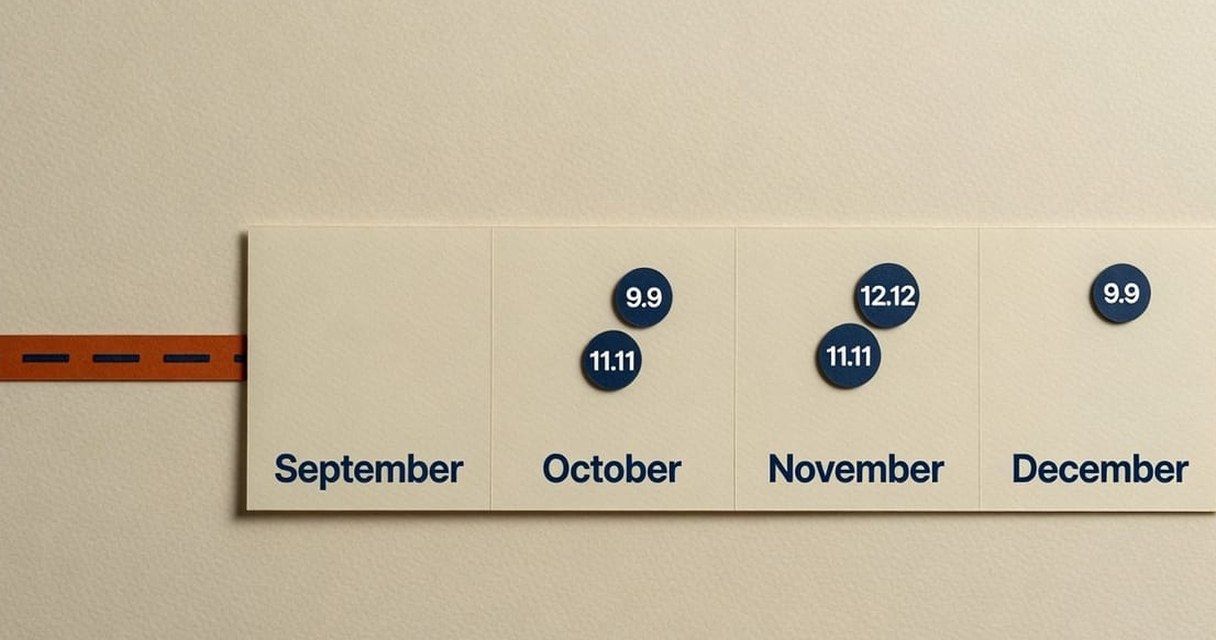
After 9.9, lock three things before 11.11: the A-class safety stocks, the exception owner for campaign week, and the rule that ads do not scale on a SKU that cannot cover lead time. Then do not reopen the file on 11.10 at midnight to “just tweak” a hero SKU. That tweak is how you stock out at noon.
Returns and the 9% you don’t get back
Ecommerce returns are forecast at about US$379 billion in 2026[4].
Roughly 9% of retail returns are fraudulent[5]. For a lean team that is not a fraud-ops seminar. It is a reason the inbound number in your reorder point is not the same as the on-hand you can sell.
Net the forecast for A-class SKUs against the return rate you actually see, not the one in the marketplace interface after they have already refunded. A 15% return rate on a campaign colourway is a planning input. Treat it as one, or you will reorder a problem.
The rest is people. A 30-day loop that nobody runs on week five is a spreadsheet. The same adoption discipline we use in corporate AI training applies: a named owner, a weekly exception meeting that lasts fifteen minutes, and a check after the next campaign window to see whether the flags fired in time.
Sources
- Gartner, “Gartner Forecasts Supply Chain Management Software with Agentic AI Will Grow to $53 Billion in Spend by 2030,” Apr. 7, 2026 — 60% of enterprises using SCM software adopting agentic features by 2030, up from 5% in 2025. gartner.com
- Cube / Momentum Works: combined Shopee + Lazada + TikTok Shop GMV in the Philippines ~US$22 billion in FY2025; Shopee Q4 = 31% of its own Philippine year; TikTok Shop Q4 = 35% of combined top-three quarterly GMV. cube.asia
- Forecast-accuracy lifts of 30–50% and 25–40% fewer stockouts are the planning range commonly cited for AI demand-planning programmes (McKinsey-class studies on forecast-error reduction sit in the 20–50% band). Measure on your own A-class SKUs over a campaign-inclusive hold-out.
- eMarketer, “Ecommerce returns will rise to $379 billion this year despite stricter policies,” Jan. 15, 2026. emarketer.com
- National Retail Federation / Happy Returns: roughly 9% of retail returns classified as fraudulent. Forbes, Dec. 26, 2025. forbes.com
Tool prices (StockTrim, Prediko, Cogsy) are USD list-price starting points as of writing.
Convert at the live rate (this site’s AI pricing page uses BSP ₱62.21 / USD, 1 September 2026) and check the tool company before you budget.
FAQ
Common questions
What is the reorder-point formula for a lean ecommerce team?
Reorder point = (average daily sales × lead time in days) + safety stock. Safety stock covers demand variability and supplier slip. AI helps you estimate the inputs; a person still sets the buffer before 11.11.
Do I need enterprise supply-chain software under 500 SKUs?
No. Under 50 SKUs, a spreadsheet plus Claude is enough. From 50–500, StockTrim (from US$49) or Prediko (US$119) covers most Shopify merchants. Cogsy (US$199) is the 500+ rung, not the starting one. Convert at the live rate — our pricing page uses ₱62.21 / USD as of 1 September 2026.
When should a Philippine seller use 9.9?
As a recalibration, not as the main event. 9.9 is the dress rehearsal before 11.11 and 12.12 — the windows that actually move the year. Shopee’s Q4 2025 was 31% of its own Philippine year; TikTok Shop took 35% of the three platforms’ combined Q4 GMV.
Can AI stop stockouts on its own?
No. It can forecast and flag. It cannot place the PO, argue with a supplier, or decide to air-freight a hero SKU. That’s the exception list: the model raises the flag, a person spends the money. Industry planning ranges often quote 30–50% better forecast accuracy and 25–40% fewer stockouts (McKinsey-class studies on forecast-error reduction sit in a 20–50% band). Measure it on your own A-class SKUs over a campaign-inclusive hold-out — not a software sales slide.
Where does this sit next to LOKAL’s ecommerce work?
Ads and storefronts fill the funnel; this page is what happens when the funnel works. Inventory, reordering and exception-handling sit with ecommerce Philippines and automation — not as a separate SAP project.
Your next step
Want the forecast-to-exception loop built on your catalogue?
If you want help putting this into practice, bring one task and its constraints.
We wire demand signals, reorder points and exception flags into the stack you already run — Shopify, Shopee, Lazada, TikTok Shop — then train the person who owns the PO. Inventory, not another ads interface.